Energy Revolution System Pricing: Is It Worth Buying?

Energy Revolution System pricing starts at about $39 for the digital guide, but the total cost is higher once you buy the required parts.
Most builders spend around $100–$200 on materials, making the real investment closer to $140–$250.
This article breaks down the full cost, refund policy, and whether it offers good value for the money.
Energy Revolution System Cost Breakdown
Here is a quick breakdown of the Energy Revolution System pricing.
The figures below are based on the official sales page, ClickBank information, and recent buyer reports.
| Cost piece | What you pay |
|---|---|
| Base digital guide | Around $39, sometimes $29 on promo |
| Listed “regular” price | Often shown as $97 to $149 |
| Full package with bonuses | Around $67 |
| Parts and materials | Roughly $63 to $210 |
| Total real cost to build | About $115 to $290 |
| Monthly or subscription fee | None |
| Refund window | 60-day money-back through ClickBank |
Read that table twice. The guide price is the small part. The materials are where your wallet actually opens.
Anyone telling you the Energy Revolution System cost is “just $39” is leaving out the half that matters.
What Does the Energy Revolution System Cost?
Let me start with the digital guide itself, since that is the price you see plastered on the sales page.
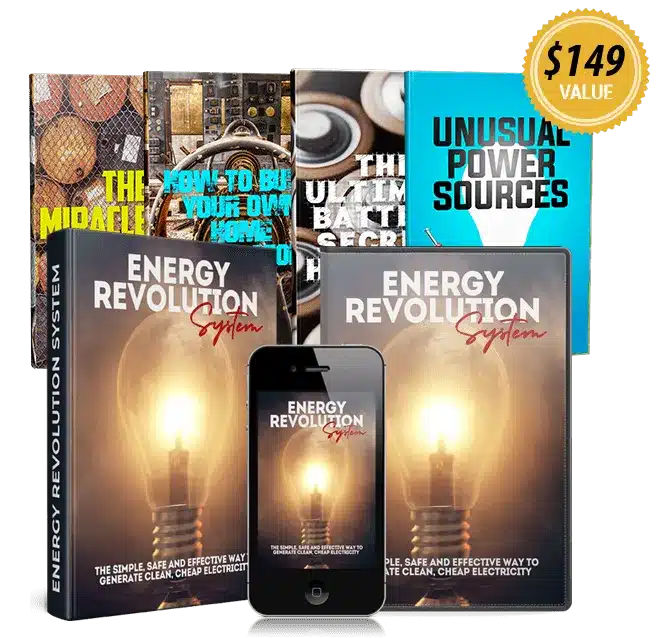
The base Energy Revolution System price sits around $39 as a one-time digital purchase. During promotions, some buyers grab it for as low as $29.
The sales page usually shows a crossed-out “regular” price somewhere between $97 and $149 to make the discount feel bigger.
Whether anyone ever paid that higher list price is anyone’s guess, but the number you actually hand over today is in the $29 to $49 range.
For that money, you get instant access to a members’ area. You download PDF blueprints, wiring diagrams, a full materials list, video tutorials, and a few bonus guides. Nothing ships to your house. You pay, you download, you build. That is the model.
The Base Price Versus the Full Package
Some checkout pages offer a bigger bundle with extra bonus material, priced around $67. This package usually adds advanced build notes and scaling tips. You do not need it to complete the basic generator, so do not feel boxed into the larger option. The $39 base guide contains everything required for a first build.
Is There a Monthly Fee?
No. The Energy Revolution System pricing model is a single one-time payment. There is no subscription, no recurring charge, and no surprise monthly bill landing in your inbox. You pay once, and the files are yours to keep.
That is one honest point in the product’s favor, and it sets it apart from the many digital products that quietly bill you every 30 days.
The Hidden Cost Most Buyers Forget: Parts and Materials
Here is where the real Energy Revolution System cost lives, and where most rushed buyers get a small shock.
The guide is just instructions. To build anything, you need to buy the physical parts yourself from a hardware store.
Expect to spend somewhere between $63 and $210 on materials, depending on how big you build and what your local prices look like.
A small starter unit lands at the low end. A larger build with better components climbs toward the top.
The good news is that the parts are common. You can find them at Home Depot, Lowe’s, or the equivalent chain in your country, like B&Q in the UK or Bunnings in Australia.
The materials list calls for wire, magnets, a coil base, and basic connecting hardware. Nothing exotic, nothing you have to special-order.
You will also need a few hand tools. Most builders already own these:
- A drill
- A screwdriver
- Wire strippers
- Pliers
A soldering iron is not required for the basic build, though it helps if you later try the advanced versions.
If you already keep a normal toolbox, your tool cost is zero, which keeps the project friendlier on the budget.
The Total Cost to Build the Energy Revolution System
Now let me add it all up so you see the honest bottom line.
When you stack the guide and the parts together, your real Energy Revolution System pricing total runs from about $115 to $290. That covers the $29 to $49 download plus the $63 to $210 in materials. Most careful first-timers land somewhere in the middle, around $150 to $200 all in.
And there is a third cost the sales page never mentions: your time. Buyers report spending anywhere from 8 to 40 hours on the build, with most landing around 15 to 22 hours spread across several sessions.
If you value your weekend hours, fold that into your personal math. The guide is cheap. The project is not free once you count the clock.
So the next time you see “build your own power source for the price of a pizza,” remember the pizza was just the entry fee.
A Worked Example of the Real Cost
Numbers feel clearer with a real scenario, so let me walk one through. Say you grab the guide during a promotion for $29. You head to the hardware store and spend $140 on wire, magnets, a coil base, and connectors for a mid-size build. You already own a drill and pliers, so your tool cost is zero. Your cash total comes to $169.
Now add your time. You spread the build across four calm weekend sessions, about 18 hours in all. If you mentally price your time at even $15 an hour, that is another $270 in effort, though it is effort you might find fun rather than painful.
Cash-wise, you are out $169. Time-wise, you invested a real chunk of two weekends. That full picture is the honest Energy Revolution System cost, and it looks very different from the $29 splashed across the ad.
Why Parts Prices Swing So Much
Your materials bill depends on a few things. Build size is the biggest one, since a larger unit needs more wire and bigger magnets. Local pricing matters too, because copper wire and magnets cost more in some regions than others. Component quality plays a role as well. Cheaper magnets and thinner wire trim your bill but can drag down your output, while better parts cost more and tend to perform better. Buyers who chase the rock-bottom parts list often end up rebuilding with stronger components later, which quietly doubles the materials spend. Buy decent parts the first time and you usually save money over the long run.
Energy Revolution System Upsells Explained
Like most digital products on ClickBank, the Energy Revolution System shows extra offers at checkout. These upsells usually cover advanced configurations and ways to scale your build to a larger size. Pricing on these add-ons has been spotted at higher tiers, climbing past the base guide.
Here is the plain advice. You do not need the upsells to get started. The base guide stands on its own.
The smart move is to skip the extras on your first purchase, build the basic unit, and only consider the advanced material if your first build goes well and you want to expand.
Buying every add-on before you have even wound your first coil is how the Energy Revolution System cost balloons past what you planned to spend.
The 60-Day Money-Back Guarantee
This is the part of Energy Revolution System pricing that protects you, so read it carefully.
The product comes with a 60-day money-back guarantee handled through ClickBank. ClickBank is the retailer, not the product creator, and it processes refunds directly. That means you do not need the vendor’s cooperation to get your money back.
You contact ClickBank support or the email inside the product materials, ask for a refund within the 60-day window, and the process runs without the friction you find on shady one-off sites. Buyers across forums confirm the refund works as described.
One catch you must keep in mind: the guarantee covers the price of the guide, not the money you spent on parts. So if you buy $150 in materials and then request a refund, you get the $39 back, not the $150.
That part of your spending is always your own risk. Plan your parts budget with that fact front and center.
Two quick habits make the refund safer. Pay with a credit card rather than a debit card for the extra layer of consumer protection, and save your purchase confirmation email. Small steps, real peace of mind.
Is the Price Worth It? Cost Versus Real Savings
Now for the question hiding behind all the Energy Revolution System pricing talk. Will the savings pay back what you spend?
Here is the honest math. The ads promise up to 80 percent off your bill. Real buyers and independent testers report far smaller numbers, usually $25 to $50 a month in savings, which works out to roughly a 14 to 20 percent cut for many homes.
Some users push higher, but those cases usually involve extra builds, ideal conditions, or partial off-grid setups that cost more money and effort.
Run the simple numbers. Say you spend $180 all in, and you save $35 a month. That is a payback of about five months, after which the savings are gravy. Not bad for a weekend project, as long as you build it well.
But flip the script. If your build is sloppy, your coil winding rushed, and your savings land at $10 a month, your payback stretches past a year, and the shine wears off fast.
Build quality decides whether the Energy Revolution System cost turns into a smart spend or a wasted afternoon. For a deeper look at the real-world results and whether the device delivers, see this full Energy Revolution System Review before you decide.
Energy Revolution System Pricing vs Solar and Portable Generators
A fair price comparison needs context, so let me line up the Energy Revolution System against the two options people weigh against it.
| Option | Upfront cost | What you get |
|---|---|---|
| Energy Revolution System | $115 to $290 total | Small supplemental power, a learning project |
| Portable solar generator | $300 to $3,500 | Ready-to-use backup box from brands like Jackery or EcoFlow |
| Home solar panel system | $4,500 to $20,000+ | Whole-home power, metered savings, added home value |
Look at that spread. The Energy Revolution System price is by far the cheapest entry point, which is its single biggest selling angle. You spend a couple hundred dollars instead of a couple thousand.
But cheap and powerful are not the same thing. A portable solar generator costs more, yet it arrives ready to plug in and reliably powers your gear during an outage. A full solar setup costs a small fortune, yet it produces measured, metered electricity that can save tens of thousands of dollars over 25 years and can lift your home’s resale value.
The Energy Revolution System does none of that. It is a small helper and a fun build, priced like one.
So the right way to read the Energy Revolution System cost is this: you are paying hobby money for a hobby-scale result, not utility money for a utility-scale fix. Match your spending to that reality and you will not feel cheated.
How To Get The Best Energy Revolution System Price?
If you decide the project fits you, a few moves keep your Energy Revolution System pricing as low and as safe as possible.
First, buy only from the official website. Copies floating around third-party sites and marketplaces may be outdated, altered, or stripped of the refund protection. Going straight to the source keeps your files current and your 60-day guarantee valid.
Second, watch for the promotional price. The official site runs frequent promotions, and the base guide often drops to $29 during these windows. If you are not in a rush, a short wait can save you ten dollars.
Third, skip the upsells on your first order. Build the basic unit, learn the process, and only buy the advanced add-ons if you genuinely plan to scale up. This single habit keeps the Energy Revolution System cost from quietly doubling at checkout.
Fourth, shop your parts smart. Compare prices at more than one hardware store, and check whether you already own the tools. A little price hunting on materials saves more than the discount on the guide ever will, since the parts are the bigger expense.
Red Flags and Honest Cautions on the Price
A truthful breakdown of Energy Revolution System pricing has to flag the warning signs too, because a low price does not erase a stretched promise.
Start with the vendor’s own words. The published terms on the official website describe the product as an experiment that was not technically assessed. Sit with that for a second. The seller themselves frames it as an experiment, not a guaranteed power solution. That disclaimer is the most honest line on the whole site, and it tells you to spend with experiment-level expectations, not miracle-level ones.
Next, the physics. Some marketing pages suggest the device gives you more power out than you put in, like a self-running loop. That breaks the basic law of conservation of energy, and no coil winding bends that rule. The unit needs a starting power input, and it produces a small, supplemental output. It does not create free energy from nothing. Treat any “endless free power” claim as advertising, not engineering.
Last, the savings hype. The 80 percent figure is the number that fuels most “scam” searches. The real range is far smaller. If the $39 price tag tempts you because you pictured a zero-dollar bill, slow down. The price is fair for what the product is. It is a terrible deal for what the ads pretend it is.
Who Gets Real Value for the Money
The Energy Revolution System cost is worth it for a specific kind of buyer and a waste for everyone else. Here is how to tell which one you are.
The price works for you if you are:
- A DIY hobbyist who enjoys building things on a weekend.
- A budget-minded homeowner or renter curious about energy independence.
- A prepper who wants a cheap, quiet backup power option for outages.
- Someone fascinated by Tesla-era electromagnetics and hands-on learning.
The price is a poor fit if you are:
- A homeowner expecting a big, fast cut to a high electric bill.
- Someone with no interest in tools, wiring, or step-by-step building.
- A buyer who wants a ready-to-use device delivered to the door.
- Anyone hoping to replace their utility connection entirely.
For the first group, $115 to $290 buys a genuinely fun project with a refund safety net on the guide. For the second group, that same money is better saved toward a portable solar generator or put toward simple home efficiency upgrades, which deliver steadier results.
Final Thought On Energy Revolution System Pricing
Here is the straight summary you came for. The Energy Revolution System price is genuinely low at the door, around $39 for the guide, with no monthly fee and a real 60-day refund behind it. That part is fair and honest.
The catch is everything the headline price hides. Add $63 to $210 in parts, fold in 15 to 22 hours of your time, and your true Energy Revolution System cost lands closer to $150 to $290 for a working build.
The savings are real but modest, usually $25 to $50 a month, not the 80 percent the ads wave around.
The seller even calls the product an experiment in its own terms, which is the clearest signal of all on how to set your expectations.
So is the price worth it? For the curious builder, the weekend tinkerer, and the budget-minded prepper, yes. A couple hundred dollars buys a fun project, a small backup power source, and a real lesson in how Tesla-era coils make current. For the buyer chasing a wiped-out electric bill, no.
That dream costs far more, and it lives in solar panels, not in a $39 download. Know which buyer you are, plan for the full Energy Revolution System pricing, and you will spend your money with open eyes.
Frequently Asked Questions About Energy Revolution System Pricing
How much does the Energy Revolution System cost in total?
The guide runs about $29 to $49, and parts add roughly $63 to $210. Your real total lands between $115 and $290 depending on build size and local prices.
Is there a monthly subscription fee?
No. The Energy Revolution System pricing is a single one-time payment. There are no recurring charges or hidden subscription costs.
Why is the advertised price so low?
The $39 figure covers only the digital guide. The parts you buy yourself are the larger expense, which the headline price does not include.
Does the price include the parts?
No. The price covers the blueprints, videos, and instructions. You source and pay for the physical materials separately at a hardware store.
Is the 60-day refund real, and does it cover the parts?
The refund is real and processed by ClickBank within 60 days. It covers the guide price only, not the money you spent on materials.
Are the upsells worth buying?
The base guide is enough to complete a build. The upsells cover advanced scaling and are only worth considering after a successful first build.
Where is the cheapest place to buy it?
Buy from the official website to get the promotional price and keep your refund protection. Avoid third-party copies, which may be outdated and unprotected.